
Journal / Trends
LED face masks and red light therapy at home: what to expect.
LED masks are everywhere, and the before-and-after photos can be persuasive. Here is what the trend promises, what the research actually supports, how a home mask differs from a professional device, and how to look after your eyes if you decide to try one.
The short answer
LED face masks can do something, but less than the trend suggests. Blue and red light have reasonable evidence for mild to moderate pimples, and red light shows modest, still-developing evidence for fine lines and redness. Home masks are weaker than the devices dermatologists use, so expect subtle change with regular use rather than dramatic results. They do not treat blackheads, whiteheads or deep cystic acne. Protect your eyes, follow the instructions, and check with a doctor first if you take medicines that make you sensitive to light.
01 / The basics
What an LED face mask actually does.
LED (light-emitting diode) light therapy shines visible light, and sometimes near-infrared light, onto the skin. It is non-invasive and does not use ultraviolet light. Dermatologists and estheticians use it in clinic, often alongside creams or facials, and home versions come as masks and handheld devices.[2]
- Blue light
- Works near the surface of the skin. It is thought to act on the bacteria involved in acne, which is why blue light is mostly sold for breakouts.[2]
- Red light
- Reaches a little deeper. It is believed to calm inflammation and support collagen production, which is where the “anti-ageing” promise comes from.[2][3]
- Near-infrared
- Not visible to the eye, and reaches deepest of the common wavelengths. Many masks combine it with red light.[2]
Notice the words “thought to” and “believed to”. The way light affects skin cells is still being studied, and that uncertainty matters when you are deciding whether a device is worth the money.
02 / What is actually known
Do LED masks work? The trend vs the evidence.
The honest answer depends on what you want the mask to do.
- Pimples
- This is where the evidence is clearest. The American Academy of Dermatology (AAD) says blue, red and combined light devices can treat pimples.[1] A 2025 review in JAMA Dermatology pooled six randomised trials of at-home LED devices in 216 people with mild to moderate acne and found fewer spots than in control groups, with combined red and blue devices possibly working best. The authors also noted that devices and settings varied widely and that the results may not apply to every device on the market.[4]
- Blackheads, whiteheads, cysts
- The AAD is clear that visible light is not effective against blackheads, whiteheads, acne cysts or nodules.[1]
- Fine lines, tone and redness
- Research suggests red light may help with fine lines, redness and dark spots, and a Harvard Health dermatologist describes the literature as legitimate, while noting that the ideal session length has not been worked out.[3] A 2024 review of home facial devices found improvements reported in LED studies, but the studies were few, small and mostly not randomised, and the authors called the efficacy data insufficient.[5]
So the evidence is real but modest, and stronger for breakouts than for ageing. Before-and-after photos online are not evidence: lighting, angle, make-up and the rest of a person’s routine can all change how skin looks. Even with a well-made device, the AAD says there is no way to know who will see results.[1]
03 / Two different tools
A home mask or a professional device?
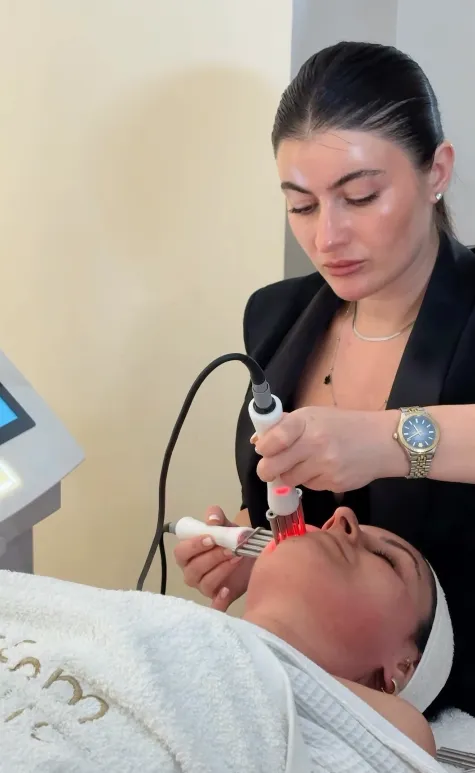
Home LED devices are less powerful than the ones a dermatologist uses.[1] Cleveland Clinic notes that in-office treatments use stronger light, and that with masks and other portable devices you are unlikely to see dramatic anti-ageing or acne results, though subtle improvement is possible.[2] Professional devices are also likely to control the dose better, and with home products it is hard to know which device is the right one to buy.[3]
A home mask is a commitment of time rather than a one-off. The AAD describes some home acne devices being used twice a day over several weeks,[1] and Harvard Health says red light devices need to be used several times a week for months.[3] If that sounds unlikely to fit your life, the money may do more elsewhere; where to spend and where to save is a useful check.
A device also cannot look at your skin. If what you want is a fresher, more comfortable complexion, a professional facial chosen for your skin is a different route: see facial skin care or Frozen Face Pro Max, and when professional skincare belongs in the plan for how to decide.
04 / Safety
Eyes, medicines and your skin.
LED therapy is generally considered safe, with few side effects. Those reported include redness, rash, inflammation and discomfort, and long-term safety data are limited.[2] In the acne trials, side effects were minor: dryness, redness and discomfort.[4]
Ask a doctor before using an LED device if you:
- take a medicine that makes you more sensitive to light; Cleveland Clinic names isotretinoin and lithium as examples;[2]
- have a history of skin cancer, or an inherited eye condition;[2]
- have darker skin, which may be more sensitive to visible light; Harvard Health suggests checking with a dermatologist first.[3]
If you are pregnant, have a skin condition or are under medical treatment, ask your doctor too.
Your eyes deserve particular care. Cleveland Clinic advises wearing eye protection, such as goggles, and following the device instructions carefully,[2] and Harvard Health says to make sure the light is not going into your eyes and to use shields if they are provided.[3] In 2019 one well-known acne light mask was withdrawn in the UK and Ireland over a “theoretical risk” of eye injury for a small group of people with certain eye conditions or taking light-sensitising medicines.[6] That is not a reason for alarm, but it is a reason to take eye safety seriously.
05 / If you decide to try
How to try an LED mask sensibly.
-
Be clear about the goal.
Mild, inflamed pimples are the most realistic reason. For lines or tone, treat it as a possible extra, not a replacement for daily sun protection and a routine you keep up.[3] Choosing a sunscreen you will actually use will do more for most skin.
-
Choose with care.
Cleveland Clinic suggests a device cleared by a medical device regulator (it mentions FDA clearance in the United States), and following its instructions closely.[2] Be wary of devices sold only through social media with no clear manufacturer information.
-
Change one thing at a time.
Start the mask while the rest of your routine stays the same, so you can tell what is helping and what is irritating. The approach in how to introduce a new skincare product works for devices too.
-
Stop if your skin objects.
Lasting redness, stinging or a rash is a reason to pause. If it does not settle, sensitive skin, or a routine that has become too much? can help you work out what changed.
Not sure a home device is worth it for your skin?
A consultation can look at your skin, your routine and what you are hoping to change before you spend on a device.
Explore a consultation06 / Beyond a device
When it is a medical matter.
A mask is not a treatment plan for acne that is deep, painful or scarring, for cysts and nodules, which visible light does not treat,[1] or for redness that keeps coming back. Those belong with a doctor or dermatologist, who can diagnose the cause and decide on treatment. Self-diagnosis is not reliable here, because acne, rosacea and irritation can look alike. When a skin concern needs a dermatologist sets out the signs, and medical spa or skincare studio? explains where each kind of care fits.
A few common questions
Frequently asked questions.
Do LED face masks actually work?
For mild to moderate pimples, research suggests they can help: a 2025 review of six trials found fewer spots with at-home LED devices than without. For fine lines and tone the evidence is more limited. Home masks are weaker than professional devices, so expect subtle change with regular use rather than dramatic results.[4][2]
What is the difference between red and blue light therapy?
Blue light works near the surface and is thought to act on acne bacteria. Red light reaches a little deeper and is believed to calm inflammation and support collagen. Many acne devices combine the two.[2]
Are LED masks safe for your eyes?
Protect them. Cleveland Clinic advises wearing eye protection and following the device instructions, and Harvard Health says to keep the light out of your eyes and use any shields provided. If you have an eye condition or take medicines that make you sensitive to light, ask a doctor before using one.[2][3]
How long does red light therapy take to show results?
Who should not use an LED face mask?
Ask a doctor first if you take light-sensitising medicines such as isotretinoin or lithium, have a history of skin cancer or an inherited eye condition, are pregnant, or are being treated for a skin condition. People with darker skin may be more sensitive to visible light and may want to check with a dermatologist first.[2][3]
Is an LED facial in a clinic different from a home mask?
Sources & scope
This Journal article offers general skincare education about home LED devices. It does not provide a diagnosis, recommend a specific device or replace individual medical advice. If you have a skin condition, an eye condition or take regular medication, speak to a doctor before using a light device. The points above draw on the following published resources.
- Acne: lasers and lights (American Academy of Dermatology): what blue and red light can and cannot treat, and how home devices compare.
- LED Light Therapy (Cleveland Clinic): what the light colours do, home versus in-office devices, side effects, eye protection and who should avoid it.
- Red light therapy for skin care (Harvard Health Publishing, 2025): the evidence, dose, home devices, eye safety and expectations.
- At-Home LED Devices for the Treatment of Acne Vulgaris: A Systematic Review and Meta-Analysis (Ershadi and Barbieri, JAMA Dermatology, 2025): pooled results and limitations of home LED trials for acne.
- Development of Home Beauty Devices for Facial Rejuvenation: Establishment of Efficacy Evaluation System (Bu et al., Clinical, Cosmetic and Investigational Dermatology, 2024): a review of home facial devices, including LED, and the quality of the evidence.
- Eye injury risk prompts recall of Neutrogena light therapy acne mask (Association of Optometrists, 2019): the recall and the people considered at risk.
Editorial: Merve Akkaya Journal. Learn more about Merve Akkaya.
Continue reading
A little more clarity.
Before you buy a device
Start with your skin, not the mask.
Whether a home LED mask makes sense depends on what your skin is doing, what you already use and how much time you can give it. A consultation looks at all three before you spend.
Tell us what you are hoping to change and which device you are considering. If a professional facial or a simpler routine would serve you better, we will say so.
A skincare consultation does not replace a medical assessment.