
Journal / Device treatments
Choosing a professional facial: where Frozen Face Pro Max fits.
A device facial that combines several technologies in one session can sound like the obvious choice. Whether it is the right one depends on what your skin needs and how it tolerates being treated.
The short answer
Frozen Face Pro Max is a needle-free facial device that its manufacturer describes as combining several technologies, including vacuum peeling, cooling, radiofrequency and ultrasound. It may suit someone who wants a multi-step device facial and whose skin tolerates treatment well. Which steps are used, and whether it is suitable at all, should be settled in a consultation.
01 / Starting point
A facial is chosen by purpose.
Facials are often chosen by name, by what a friend had or by what looks most advanced. A more reliable method is to begin with your skin.
Ask what you want from the session: a thorough cleanse, help with congestion, comfort for dry skin, attention to firmness, or care before an occasion. Then ask how your skin copes with being treated. Skin that reacts easily calls for a different plan from skin that tolerates most things.
With those two answers, the question of which facial becomes easier. How to understand what your skin may need can help with the first, and when professional skincare belongs in the plan with the wider decision.
02 / The device
What Frozen Face Pro Max is.
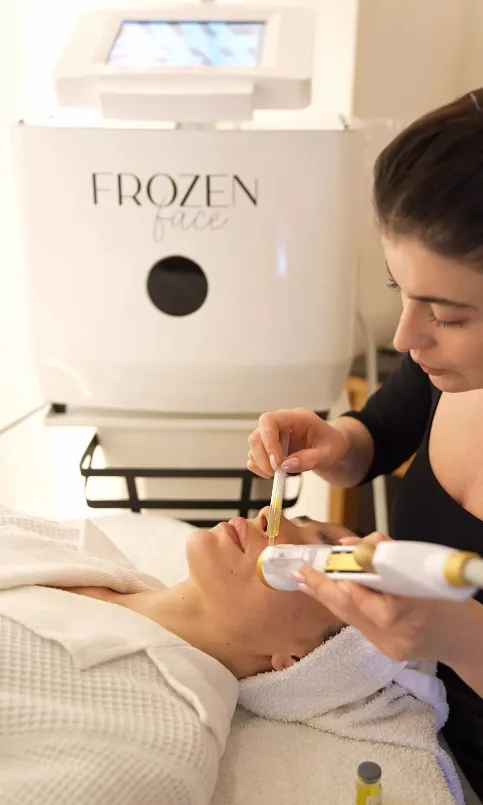
Frozen Face Pro Max is a facial device from the Turkish manufacturer D2 Grup. The company describes it as a needle-free system that brings several technologies together in one unit.[1]
According to the manufacturer’s product page, these include:[1]
- Vacuum peeling, used with one of three solutions chosen for the skin type, intended for pore cleansing.
- A hydrogen and oxygen dome.
- A handpiece combining electroporation, cooling (cryo), radiofrequency and ultrasound.
- An electromagnetic function directed at the facial muscles.
The manufacturer presents it as suitable for use in all four seasons and as a treatment that does not interrupt daily life afterwards. It also states that results vary from person to person.[1]
03 / Reading the description
How to read manufacturer claims.
Product pages are written to sell equipment to clinics. They describe what a device is designed to do, in the most favourable terms, and they are not the same as independent evidence of what it will do for you.
Three habits help.
- Separate function from promise
- “Combines vacuum peeling and cooling” describes a function. “Anti-ageing” describes a hope. Ask about the first.
- Ask what applies to you
- A device with several functions does not mean every function is used in every session. Ask which steps your practitioner would use on your skin, and why.
A practitioner who explains a treatment in plain terms, including its limits, is giving you better information than any brochure.
04 / Matching skin and treatment
Where it may fit.
- It may be relevant if
- You would like a multi-step device facial, your skin generally tolerates treatment, and your interests include cleansing, texture and the appearance of firmness.
- A classic facial may suit better if
- You prefer hands-on care, your concern is straightforward, or you are new to professional treatments. See Facial Skin Care and Frozen Face Pro Max or Facial Skin Care: how to discuss the choice.
- Discuss carefully if
- Your skin reacts easily. Read Frozen Face Pro Max and sensitive skin: what to discuss and sensitive skin or a routine that has become too much.
- See a doctor first if
- You have active acne that is deep or painful, a rash, an infection or broken skin in the area, or an undiagnosed skin change.
If firmness is your main interest, another device may be more relevant; see skin firmness and facial care: where Forma fits.
05 / Before you book
Questions to bring with you.
- Which of the device’s functions would be used on my skin, and which would not?
- Why those, given my skin and my goal?
- What will I feel during the session and how might my skin look afterwards?
- Is one session meaningful or is a course suggested?
- What should I stop or change at home beforehand?
- What should I avoid afterwards, and for how long?
- When would you advise against this treatment?
Share your own information too. Mention pregnancy, any implanted electrical or metal device, recent cosmetic procedures or injectables, a history of cold sores, skin conditions and all medication. See recent cosmetic procedures: what your skincare practitioner needs to know.
Tell your practitioner about retinoids and exfoliating products in particular. The AAD notes that prescription retinoids, retinol and benzoyl peroxide can make skin more sensitive or cause it to peel,[4] which matters before any treatment that includes peeling. Before a facial: what to tell your skincare practitioner has a fuller list.
See the treatment page.
The Frozen Face Pro Max page describes the service. A consultation comes before any session.
Explore Frozen Face Pro Max06 / Timing and home care
Fitting it into your plans.
Two practical matters are worth settling early.
Events. If you are thinking of a treatment before an occasion, do not leave it to the last days and do not try anything for the first time just beforehand. See Frozen Face Pro Max before an event: planning the timing and skincare before an event.
Home routine. What you use at home in the days around a treatment affects how your skin responds. See Frozen Face Pro Max and your home routine: coordinating care and after a facial: keeping your home routine clear.
When the next step is medical
A device facial does not diagnose or treat skin conditions. Persistent redness, painful breakouts, rashes and unexplained changes should be seen by a dermatologist first.
If you are pregnant, or have a medical condition or an implanted device, ask your doctor before any device treatment.
A few common questions
Frequently asked questions.
What is Frozen Face Pro Max?
It is a needle-free facial device made by D2 Grup. The manufacturer describes it as combining several technologies in one system, including vacuum peeling, cooling, radiofrequency and ultrasound.[1]
Is it better than a classic facial?
Neither is better in general. A device facial and a hands-on facial suit different skins and different goals. The right choice depends on your concern and how your skin tolerates treatment.
Does every session use all the technologies?
Not necessarily. Ask your practitioner which functions would be used on your skin and why.
Is it suitable for sensitive skin?
That needs an individual conversation. Tell your practitioner how your skin reacts to products and treatments before deciding.
Is there downtime?
The manufacturer presents the treatment as one that does not interrupt daily life.[1] Ask your practitioner what to expect for your own skin and what to avoid afterwards.
Sources & scope
This Journal article offers general skincare education and an orientation to one device facial and the questions to ask about it. It does not provide a diagnosis, prescribe treatment or replace individual medical advice. The points above draw on the following published resources.
- Frozen Face Pro Max (D2 Grup, manufacturer product page, in Turkish) — how the manufacturer describes the device and its technologies.
- Many ways to firm sagging skin (American Academy of Dermatology) — what non-surgical firming procedures can realistically offer.
- How to select anti-aging skin care products (American Academy of Dermatology) — realistic expectations and how to read product claims.
- How to safely exfoliate at home (American Academy of Dermatology) — products that make skin more sensitive to exfoliation.
Editorial: Merve Akkaya Journal. Learn more about Merve Akkaya.
Continue reading
A little more clarity.
Start with a conversation
The right facial is the one that suits your skin.
If you are deciding between a classic facial and a device facial, describe your skin and what you hope to change. The choice usually becomes clear.
Tell us your main concern and how your skin tends to react to treatment. You can explore the consultation options before making an enquiry.
A conversation about suitability comes before choosing a treatment.