
Journal / Skincare foundations
A skincare routine does not need to be complicated.
Start with a few steps that each have a clear purpose. Everything beyond them is a choice you can make slowly, for a reason you can name.
The short answer
A dependable routine is a gentle cleanser, a moisturiser you find comfortable and daily sun protection. Add anything else one product at a time, and only when you can say what it is for. If your skin is painful, reacting or changing without explanation, seek medical advice instead of adjusting the routine.
01 / Fewer steps, clearer purpose
More steps are not more care.
A long routine can feel like commitment. Seven products in the evening, a different set in the morning, a mask on Sundays. It is easy to assume that effort and results rise together.
They do not always. The American Academy of Dermatology recommends a simple three-step approach: cleansing, moisturising and protecting the skin. It also notes that using several different products can be costly and can irritate the skin.[1]
A short routine is also easier to read. With a few products, you can tell what each one is doing. With ten, a change in your skin could come from any of them, and understanding what your skin needs becomes guesswork.
A simple routine is a starting point you can observe, and it is the easiest one to repeat on a tired evening.
A useful test
For every product on your shelf, finish this sentence: “I use this to…”. If the answer is unclear, or the same as the answer for another product, that step is a candidate for review.
02 / The foundation
Three steps, three jobs.
Each step has one job. Knowing the job makes it easier to choose a product and to notice when it is not doing what you need.
- Cleanse
- The job is to remove the day: dirt, oil, sunscreen and make-up. A gentle, non-abrasive cleanser, lukewarm water and your fingertips are enough. Scrubbing irritates the skin, so rinse and pat dry with a soft towel.[2] The AAD suggests limiting face washing to twice a day and after sweating.[1]
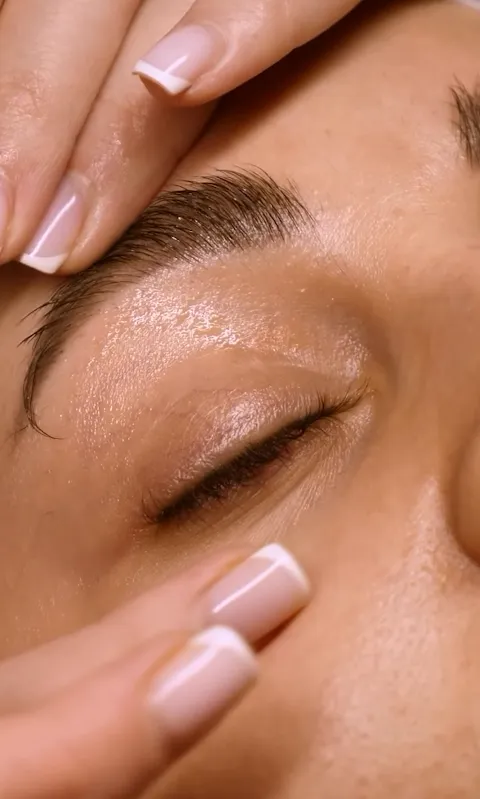
If cleansing leaves your face feeling stripped, look at the cleanser before adding a product to compensate. Tightness after cleansing is worth reviewing at the source.
For sun protection, a product you are willing to apply every day is the practical choice. Choosing a daily sunscreen covers the level of protection, the formula and how it feels on your skin.
03 / The shape of a day
Morning and evening, kept short.
Across a day, the routine looks like this.
-
In the morning.
Cleanse, moisturise, apply sunscreen. A moisturiser that contains sunscreen can combine two steps, provided it is broad-spectrum with SPF 30 or higher.[1]
Apply sunscreen before you go outdoors; the AAD notes that it takes about 15 minutes for the skin to absorb it. When you are outside, reapply every two hours and straight after swimming or sweating.[3]
-
In the evening.
Cleanse, then moisturise. The AAD advises cleansing before bed.[1] Whether one cleanse is enough depends on what you are removing; double cleansing is a separate question with its own answer.
-
If you use a treatment.
The AAD’s suggested order is to wash, apply any medication or treatment, then moisturiser and sunscreen, with make-up last.[4] Follow the directions you were given for anything prescribed.
The differences between morning and evening skincare and the detail of product order are covered in their own guides, for when you add to it.
04 / Everything else
What is optional, and how to decide.
Serums, toners, essences, eye creams, exfoliants and masks sit outside the foundation. Some of them may suit you; none is compulsory.
Before adding one, ask three questions:
- What is it for? Name one concern, in plain words.
- Is that job already covered? A second product aimed at the same concern adds cost and little clarity.
- Can I add it alone? Introducing one product at a time lets you see what it does.
The AAD cautions that using too many products may irritate the skin, particularly when more than one anti-ageing product is involved.[4] That is the risk behind layering several active ingredients at once.
Two common questions deserve a short answer here. A separate eye or neck cream is a preference, and the answer depends on how your usual moisturiser feels in those areas. And when you do add something, introduce the new product without changing the rest of the routine around it.
Price is not a measure of whether a step is necessary. The AAD is clear that products do not need to be expensive to be effective,[1] which makes where to spend and where to save a question of priorities.
Keep, pause or remove.
A Skin Edit looks at the products you already own and sorts them by purpose. Bring the list, or photographs of the labels.
See how Skin Edit works05 / Same steps, different products
Fit the routine to your skin.
Simple does not mean identical for everyone. The structure is a starting point, and the products within it should suit your skin: their texture, their formula and how well you tolerate them.
- If your skin is oily
- Keep the moisturiser and consider a lighter texture. Labels such as “non-comedogenic” or “won’t clog pores” are a reasonable place to start.[1] More on moisturiser for oily skin.
- If your skin is dry
- The AAD describes dry skin as flaky, itchy or rough.[1] A richer texture may feel more comfortable; compare cream, lotion and gel moisturisers.
- If it is both
- Dry in some areas and oily in others is common. You do not need two routines; see the guide to a combination skin routine.
- If the signals conflict
- Shine alongside discomfort can be confusing. Read about oily but dehydrated skin and the difference between hydration and moisturisation.
- If products sting
- The AAD describes sensitive skin as skin that may sting or burn after product use.[1] Note which product causes it, and look at the formula as well as the texture. A product that suits one person can irritate another.
A product can also be more than your skin wants. If a moisturiser sits heavily or you notice new congestion after switching, it may be too rich for your skin.
This structure is a common starting point, not a rule for every skin. Some people do well with less, and some concerns need something more specific. The guide to skincare for men starts from the same foundation.
If you are unsure of your skin type, the AAD recommends speaking with a dermatologist before starting a routine.[1]
06 / Beyond the basics
When a simple routine needs support.
A short routine gives you a stable base. It does not answer every question. You may want a second opinion on what to keep, or you may be considering professional care alongside what you do at home.
For a product question, Skin Edit is the focused starting point. For anything broader, a skincare consultation gives you room to describe your routine, your skin and what you would like to change. If you are curious about treatments, read when professional skincare belongs in the plan before choosing one.

Merve Akkaya’s approach to skincare starts from the same place as this article: a clear base first, additions for a reason.
When the next step is medical.
A simpler routine is not a treatment for a skin condition. Pain, a rash you cannot explain, reactions that keep returning or a concern that is getting worse are reasons to see a doctor. Read more on when a skin concern needs a dermatologist.
If you use prescribed skincare, keep using it as directed and raise any difficulty with the clinician who prescribed it.
07 / A practical place to begin
A ten-minute routine audit.
Put everything you use on one surface and sort it. You are not throwing anything away yet; you are finding out what the routine really is.
Five things to check
- Which three products are your cleanser, moisturiser and sunscreen?
- What is the stated purpose of every other product?
- Which products do the same job as another?
- Which steps do you skip most often, and why?
- Which product, if any, causes stinging, tightness or discomfort?
What remains after that sort is your routine, however short it is. A routine that fits your life is the one you will still be following in three months.
A few common questions
Frequently asked questions.
What is the simplest skincare routine that still works?
Cleansing, moisturising and sun protection. The AAD recommends this as a simple three-step approach.[1] In the morning that means cleanser, moisturiser and sunscreen; in the evening, cleanser and moisturiser.
How many skincare products do I really need?
There is no fixed number. A cleanser, a moisturiser and a sunscreen cover the basics, and a moisturiser with broad-spectrum SPF 30 or higher can do two of those jobs in the morning.[1] Beyond that, what matters is that each product has a purpose you can state and that your skin tolerates it.
Do I need a serum or a toner?
Neither is essential. A serum or toner can be a reasonable addition when it addresses a specific concern and your skin tolerates it. Add one product at a time so you can see its effect.
Should I wash my face twice a day?
The AAD advises washing once in the morning, once at night and after heavy sweating, and not more often than that, to avoid irritation.[2] Use lukewarm water and a gentle cleanser.
Can I use a moisturiser with SPF instead of a separate sunscreen?
Is a simple routine enough for acne or sensitive skin?
A gentle base is a sensible place to start, but it does not treat a medical condition. Persistent or painful breakouts and repeated reactions should be assessed by a dermatologist. If your skin has become reactive, read sensitive skin or a routine that has become too much.
How do I cut down a routine that has grown too long?
Identify your cleanser, moisturiser and sunscreen and keep those. Set the remaining products aside and return them one at a time, only if you can say what each is for. Prescribed treatments are the exception: continue them as directed.
Sources & scope
This Journal article offers general skincare education and a framework for reviewing a home routine. It does not provide a diagnosis, prescribe treatment or replace individual medical advice. General care guidance is supported by the following American Academy of Dermatology resources.
- Skin care on a budget — the three-step approach, moisturising, dual-function products and skin-type descriptions.
- Face washing 101 — cleanser choice, water temperature, technique and frequency.
- How to apply sunscreen — SPF, amount, timing and reapplication.
- Should I apply my skin care products in a certain order? — product order and the effect of using too many products.
Editorial: Merve Akkaya Journal. Learn more about Merve Akkaya.
Continue reading
A little more clarity.
Start with a conversation
A shorter routine, chosen with care.
If you are not sure which products to keep, bring what you use. The conversation starts with your current routine.
Tell us your main skincare question and whether you are interested in a routine review or professional care. You can explore the consultation options before making an enquiry.
A conversation about suitability comes before choosing a treatment.